


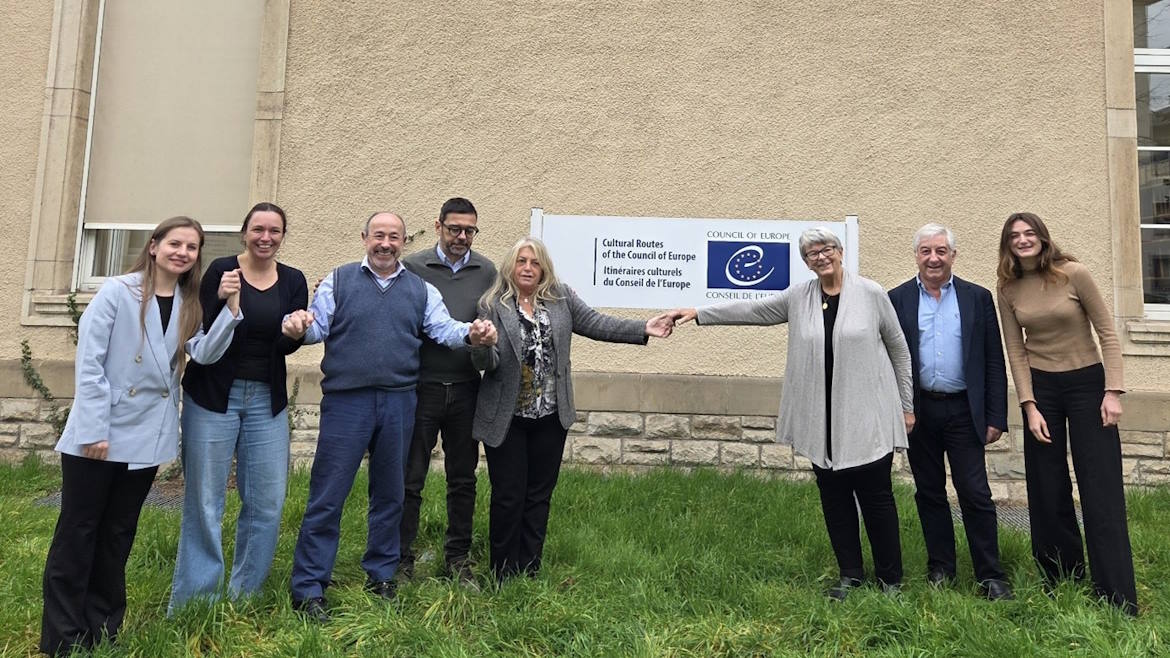
As the manager of the Roman Emperors and Danube Wine Route, we took part in the first meeting of the Informal Contact Group of Cultural Routes, held on 11–12 December 2025 at the headquarters of the European Institute of Cultural Routes in Luxembourg.
The Roman Emperors and Danube Wine Route, together with its Danube and Adriatic Trails, extends through ten European countries: Slovenia, Hungary, Croatia, Serbia, Bulgaria, Romania, Albania, Montenegro, North Macedonia, and Bosnia and Herzegovina. It represents a network of sub-destinations built around archaeological sites, locations, places, and monuments associated with the leadership and legacy of Roman emperors in Late Antiquity. The Route has been certified as a European Cultural Route by the European Institute of Cultural Routes (EICR).
The two-day meeting brought together representatives of selected Cultural Routes of the Council of Europe and the Secretariat, providing a platform to align expectations, address practical challenges faced by the routes, and strengthen mutual trust as a basis for future cooperation. Discussions focused on key topics such as inter-route cooperation, stakeholder engagement, and challenges related to brand positioning and the overall promise of the Cultural Routes programme.
The establishment of the Informal Contact Group was welcomed as an important step towards a more inclusive and structured dialogue within the programme, laying the groundwork for a renewed approach to its further development. In the coming period, efforts will focus on defining the group’s roles, responsibilities, and working methods, while ensuring transparency and democratic functioning. These principles are expected to be reflected, among other initiatives, in the programme and approach of the 13th Training Academy of Cultural Routes.
The Informal Contact Group was created to advise and support the Secretariat by ensuring that the perspectives of the Cultural Routes are taken into account in the development of the programme. It also serves as an interface between the Secretariat and the routes on matters related to networking and cooperation.
The group is composed of representatives of six Cultural Routes of the Council of Europe, including Antonio Barone (Phoenicians’ Route), Benedetta Diamanti (European Route of Ceramics), Danko Ćosić (Roman Emperors and Danube Wine Route), Inger Harlevi (The Hansa), Simone Zagrodnik (European Route of Historical Thermal Towns), and Quintín Correas Domingo (European Routes of Emperor Charles V).
Photo: www.coe.int